

The median rent in the U.S. fell for the 29th consecutive year in January 2026, according to Realtor.com’s January 2026 Rental Report. With the median asking rent at $1,672—$26 less than the previous year—rent for properties with 0–2 bedrooms decreased by 1.5% in the 50 major metro regions. The median rent in nationwide was $221 (15.2%) greater than it was in January 2020 (before to the pandemic), but only $85 (-4.8%) lower than the August 2022 peak.
Key Findings:
- For the 32nd consecutive month, the median asking rent for two-bedroom apartments fell -1.7% year-over-year in January.
- The nationwide median rent for a two-bedroom apartment was $1,847, which was $111 (-5.7%) less than the July 2022 peak. Larger unit rents, on the other hand, increased by $268 (17.0%) during the previous six years, the fastest growth rate.
- In January 2026, the rent for one-bedroom apartments fell -1.4% year-over-year to $1,552, marking the 32nd consecutive month of yearly decreases. It was $183 (13.4%) greater than in January 2020 but $105 (-6.3%) less than the August 2022 peak.
- For the 29th straight month of yearly reductions, the median asking rent for studios dropped by -1.2 percent in January 2026.
- In January, the median studio rent was $1,393, which was $86 (-5.8%) less than its peak in October 2022. However, compared to six years earlier, the median asking rent for studios was still $128 (10.1%) higher.
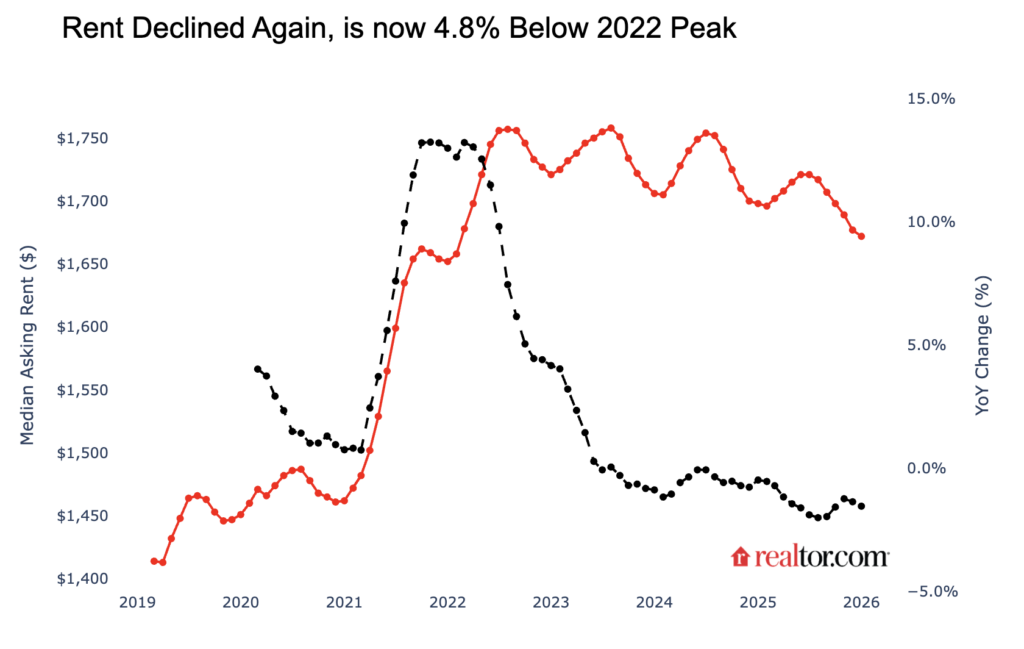
Note: Rental units include apartments as well as private rentals (condos, townhomes, single-family homes).
National Rents by Unit Size — January 2026
| Unit Size | Median Rent | Rent YoY | Consecutive Months of Decline | Total Decline from Peak | Rent Change – 6 Years |
| Overall | $1,672 | -1.5% | 29 | -4.8% | 15.2% |
| Studio | $1,393 | -1.2% | 29 | -5.8% | 10.1% |
| 1-Bedroom | $1,552 | -1.4% | 32 | -6.3% | 13.4% |
| 2-Bedroom | $1,847 | -1.7% | 32 | -5.7% | 17.0% |
Rental Vacancy Rates Affecting U.S. Rent Markets
A market with a rental vacancy rate between 5% and 7% is typically regarded as balanced, meaning that supply and demand are in good alignment. Although tenants have some options at this level, landlords are still able to lease apartments without offering significant savings. Renters typically have the upper hand in markets with vacancy rates above 7%, while landlords typically benefit from those with vacancy rates below 5%.
The average rental vacancy rate in the top 50 metro areas in 2025 was 7.6%, according to the Housing Vacancies and Homeownership Survey. This suggests that the market is renter-friendly and that renters have a sizable advantage. This indicates that things are becoming better for today’s tenants, as it is higher than the pre-pandemic average of 6.9% and up from 7.2% in 2024. Overall, six of the top 50 markets are considered landlord-friendly, approximately 22 are renter-friendly, and some 22 are balanced.
The Sun Belt contains 16 of the 22 renter-friendly markets, with Birmingham, Alabama, having the highest vacancy rate in 2025 at 14.3%. Houston (11.4%), Tampa, FL (11.4%), and Austin, Texas (13.8%), are other Sun Belt urban areas with high vacancy rates. When supply exceeds demand, as indicated by high vacancy rates, renters have more options and more negotiation power, which is reflected in declining rents. For instance, Austin’s median asking rent dropped to $1,358 in January 2026, a 7.3% year-over-year decrease that lasted for 33 months.
Six metro areas—Boston (3.2%), Riverside, CA (3.3%), San Jose, CA (3.5%), Providence, RI (3.7%), Los Angeles (4.4%), and New York (4.6%)—remain landlord-friendly despite the fact that renters now have more clout in some markets. Boston had the lowest vacancy rate of all of them in 2025, coming in at 3.2%. Nonetheless, Boston’s vacancy rate has gone up little from the previous year (3.0% in 2024), providing some respite for tenants and keeping pace with the 2.6% annual rent decrease as of January 2026. The ongoing year-over-year rent growth of 1.9% in San Jose and 0.8% in New York, along with the low vacancy rate in both cities, indicates that these markets are now in extremely tight conditions.

Rental vacancy rates increased in roughly 27 markets in 2025 compared to the previous year, indicating better rental conditions. In particular, a robust pipeline of new multifamily construction helped seven areas move into more renter-friendly territory. Two new renter-friendly markets were established: Portland, OR, and Milwaukee. The most significant change occurred in Milwaukee, where the rental vacancy rate increased from 4.9% in 2024 to 10.8% in 2025, turning the market from one that favored landlords to one that favored renters. With permits rising from 700 units in 2019 to 1,249 in 2022, 1,154 in 2023, and 2,016 in 2024, this shift is indicative of a spike in the supply of multifamily housing.
Similarly, when vacancy increased from 5.7% to 7.4% over the course of the year, Portland’s market changed from balanced to renter-friendly, with median asking rent falling 3.1% year-over-year. Renters now have more options and more negotiating power in five other locations that went from being landlord-friendly to balanced:
- Denver
- Hartford, CT
- Rochester, NY
- Sacramento, CA
- Washington, DC
Overall, rental vacancy rates decreased in an estimated 22 markets in 2025 compared to the previous year. Among these, seven areas saw a change in conditions over the previous year from renter-friendly to balanced, with vacancy rates falling from above 7% to between 5% and 7%. Large out-of-market renter demand is drawn to these markets, which include Pittsburgh, Pennsylvania, and Richmond, VA, since they are typically reasonably priced and have good employment prospects.
As a result, median asking rents rose approximately 0.9% and 1.9% year-over-year in Pittsburgh and Richmond, VA, respectively, while vacancy rates decreased from 8.7% in 2024 to 6.9% in 2025 and from 8.2% to 5.2%.
The post Leaseholder Conditions Strengthen, Shifting Toward a More ‘Renter-Friendly’ Market first appeared on The MortgagePoint.


